
Exam season can feel overwhelming when you're staring at months of material with no clear strategy. Many students dive into revision without a structured plan, leading to stress, inefficient study sessions, and patchy knowledge gaps on exam day. A well-designed revision plan transforms this chaos into a manageable, focused approach that maximises your study time and boosts confidence. This guide will walk you through creating a practical revision plan tailored to your GCSE or A-Level exams, covering everything from setting realistic goals to tracking progress and avoiding common pitfalls. You'll learn how to balance subjects, schedule breaks, and adapt your plan as you progress, ensuring you arrive at your exams fully prepared and ready to perform at your best.
Table of Contents
- Key Takeaways
- Understanding the need for a revision plan
- Preparing to make your revision plan
- Step-by-step guide to creating your revision plan
- Common mistakes and how to avoid them
- Monitoring your progress and adjusting your plan
- Discover tools to streamline your revision planning
- FAQ
Key Takeaways
| Point | Details |
|---|---|
| Structured revision plan | A well designed timetable turns chaos into a focused approach, reducing stress and improving coverage across the syllabus. |
| Realistic revision goals | Set detailed, achievable targets that align with exam weighting and topic difficulty to guide daily study. |
| Balance study and rest | Schedule breaks and personal time to maintain motivation, mental sharpness and long term recall. |
| Track progress and adjust | Regularly monitor what has been covered and adjust your plan to fill gaps before exams. |
| Proven revision techniques | Employ evidence based revision methods such as spaced repetition and active recall to boost retention. |
Understanding the need for a revision plan
Many students approach revision by randomly picking topics or cramming the night before tests, hoping something sticks. This haphazard method creates anxiety because you never know if you've covered enough material or if you're focusing on the right areas. Without structure, you might spend hours on topics you already understand whilst neglecting weaker subjects that need attention. A revision plan solves these problems by creating a clear roadmap for your study sessions.
Well-structured revision plans reduce student anxiety and improve information retention by breaking overwhelming content into manageable chunks. When you know exactly what to study each day, you eliminate decision fatigue and can focus your mental energy on actually learning rather than worrying about what to do next. Planning helps you allocate appropriate time to each subject based on difficulty and exam weighting, ensuring balanced coverage across your entire syllabus.
Another crucial benefit is how planning enables you to balance revision with personal time, hobbies, and rest. Students who schedule their study sessions can still maintain social connections and physical activity, which actually enhances learning by keeping your mind fresh. This structured approach reduces last-minute cramming, which research shows is far less effective for long-term retention than spaced repetition over weeks or months.
"The key to exam success isn't studying harder, it's studying smarter with a plan that works for your individual needs and learning style."
Effective revision planning also helps you identify knowledge gaps early, giving you time to seek help from teachers or use resources like Exam Archive AI to fill those gaps before exam day arrives. You'll walk into your exams confident that you've systematically covered everything required.
Preparing to make your revision plan
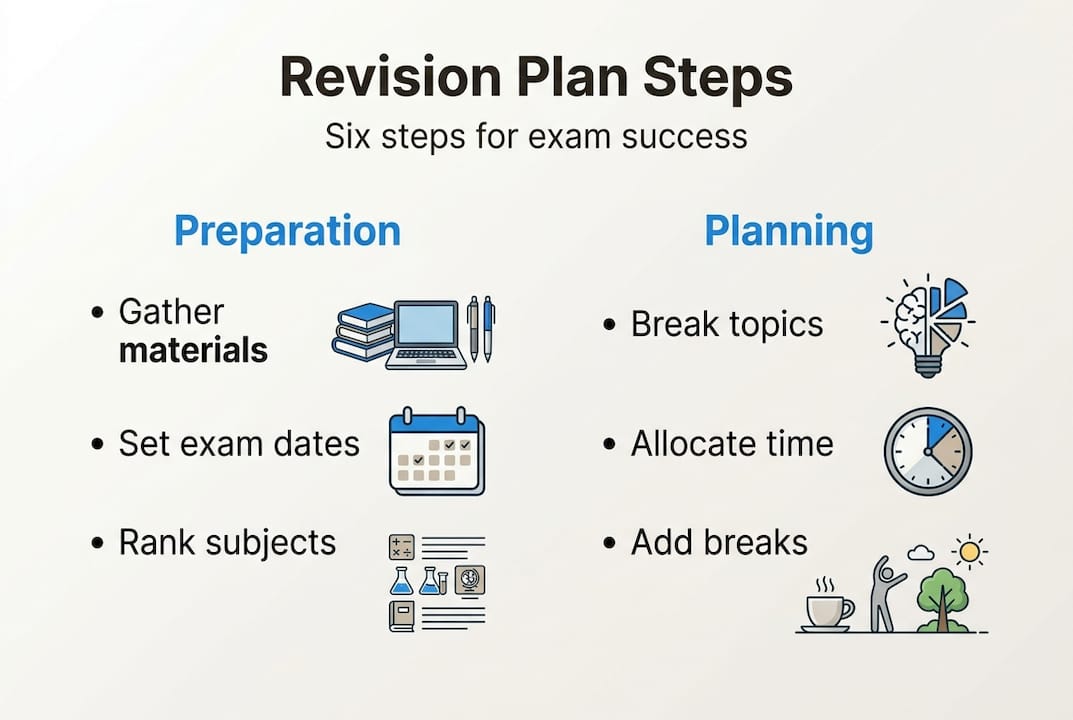
Before drafting your timetable, you need to gather essential information and materials that will form the foundation of your plan. Start by collecting your syllabus documents for each subject, which outline exactly what topics examiners can test. Most exam boards publish detailed specifications on their websites, breaking down content into units or modules. Download these and highlight areas you find challenging or haven't covered thoroughly in class.
Next, identify all your exam dates and deadlines. Create a master calendar showing when each paper occurs, including any coursework submission dates or controlled assessments. This timeline determines how much revision time you actually have and helps you work backwards to allocate study periods appropriately. Don't forget to account for school holidays, family commitments, or other events that might reduce available study time.
List every topic within each subject that requires revision. Break broad subjects into specific themes or chapters. For example, rather than writing "Biology revision", list "Cell structure, Photosynthesis, Human digestive system" as separate items. This granular approach makes planning more precise and helps you track progress more effectively.
Essential preparation steps:
- Gather syllabus specifications from your exam board
- Note all exam dates and coursework deadlines
- List specific topics requiring revision per subject
- Assess your current knowledge level in each area
- Collect past papers and mark schemes
- Prepare revision materials like flashcards and summary notes
Set SMART revision goals to guide your planning. SMART stands for Specific, Measurable, Achievable, Relevant, and Time-bound. Instead of "Get better at Maths", a SMART goal would be "Complete 10 past paper questions on quadratic equations by Friday". Knowing your exam dates and syllabus coverage is essential for effective revision planning because it ensures you're studying the right content at the right time.
| Preparation element | Purpose | Example |
|---|---|---|
| Syllabus collection | Ensures complete coverage | Download AQA Biology specification |
| Exam timeline | Sets revision deadline | Chemistry Paper 1: 15th May 2026 |
| Topic breakdown | Creates specific study targets | List 12 History themes to revise |
| Resource gathering | Provides study materials | Collect 5 years of past papers |
Pro Tip: Create a subject difficulty ranking from 1 to 10 based on your confidence level. This helps you allocate more time to challenging subjects whilst maintaining knowledge in stronger areas.
Step-by-step guide to creating your revision plan
Now you're ready to build your actual revision timetable using a systematic approach that ensures comprehensive coverage without overwhelming yourself. Follow these six steps to create a plan that's both ambitious and realistic.

Step 1: Assess available time. Count the weeks between now and your first exam. Subtract any periods when you genuinely can't study, like family holidays or major school events. Be honest about how many hours per day you can realistically dedicate to revision whilst maintaining wellbeing. Most students can manage 3 to 4 hours of focused study on school days and 5 to 6 hours on weekends.
Step 2: Break down topics. For each subject, divide your topic list into smaller study units that can be covered in one or two sessions. A complex topic like "The Cold War" might break into "Origins 1945-1950", "Cuban Missile Crisis", and "Détente period". This granularity makes progress visible and prevents sessions from becoming vague or unfocused.
Step 3: Allocate revision blocks. Distribute your study units across your available time, balancing subjects throughout each week rather than blocking entire weeks per subject. Interleaving subjects improves retention compared to massed practice. Schedule harder subjects when you're most alert, typically morning or early afternoon for most students.
Step 4: Include breaks and rest. Systematic revision schedules improve exam performance by organising study sessions optimally, but only if you schedule regular breaks. Use techniques like Pomodoro (25 minutes study, 5 minutes break) or longer blocks with 15-minute breaks. Schedule at least one full rest day per week where you don't touch revision materials.
Step 5: Plan active revision techniques. Don't just re-read notes. Schedule specific activities like practice questions, flashcard testing, mind mapping, or teaching concepts to someone else. Active recall and spaced repetition are proven to enhance long-term memory far more effectively than passive reading.
Step 6: Build in flexibility. Life happens, so don't create a rigid plan that collapses if you miss one session. Leave buffer time each week for catching up or diving deeper into topics you find challenging. Review your plan weekly and adjust based on actual progress rather than sticking blindly to the original schedule.
| Planning step | Time allocation | Focus |
|---|---|---|
| Weeks 8-6 before exams | 2-3 hours daily | Complete first pass of all topics |
| Weeks 6-4 before exams | 3-4 hours daily | Focus on weak areas, practice questions |
| Weeks 4-2 before exams | 4-5 hours daily | Past papers, timed practice |
| Final 2 weeks | 5-6 hours daily | Review, confidence building |
Pro Tip: Use different colours for each subject in your timetable. Visual distinction helps you quickly see if you're balancing subjects appropriately across the week and makes the plan less intimidating to look at.
Common mistakes and how to avoid them
Even with good intentions, students frequently make planning errors that undermine their revision effectiveness. Recognising these pitfalls helps you design a plan that actually works rather than one that looks impressive but proves impossible to follow.
The most common mistake is setting unrealistic daily targets. Scheduling 8 hours of revision every single day sounds productive but leads to burnout within a week. You're a human, not a robot, and your brain needs variety and rest to consolidate learning. Avoiding common mistakes like over-scheduling and ignoring rest improves overall revision effectiveness by maintaining sustainable study habits.
Another frequent error is neglecting difficult subjects because they're uncomfortable to study. Students often gravitate towards topics they already understand because it feels good to answer questions correctly. However, your weakest subjects offer the greatest potential for grade improvement. Force yourself to tackle challenging material early in study sessions when your mental energy is highest.
Many students also fail to schedule adequate breaks, viewing them as wasted time. Research consistently shows that breaks enhance focus and retention by preventing cognitive fatigue. Without rest, each subsequent study hour becomes progressively less effective. Your brain consolidates memories during downtime, making breaks essential rather than optional.
Mistakes to avoid:
- Creating overly ambitious daily schedules you can't maintain
- Avoiding difficult subjects in favour of comfortable ones
- Skipping breaks and rest days leading to burnout
- Failing to track actual progress against planned progress
- Making drastic last-minute changes that create confusion
- Revising in a distracting environment without focus
- Relying solely on passive reading instead of active recall
Inconsistent execution also derails many revision plans. Students create detailed timetables but then ignore them after a few days, returning to random, unstructured study. Consistency matters more than perfection. If you miss a session, simply continue with the next planned topic rather than trying to cram in everything you missed.
"A good revision plan executed imperfectly beats a perfect plan that you abandon after three days. Consistency and adaptation trump rigid perfection."
Finally, some students refuse to adjust their plans even when evidence shows certain approaches aren't working. If practice questions reveal persistent gaps in a topic, you need to revisit that material rather than blindly following your original schedule. Your plan should serve you, not the other way around.
Monitoring your progress and adjusting your plan
Creating a plan is only the beginning; tracking your actual progress and making data-driven adjustments separates effective revision from wishful thinking. Regular monitoring helps you identify what's working, what needs more attention, and how to optimise your remaining study time.
Use a revision diary or digital app to log each study session, noting what you covered, how long you studied, and your confidence level with the material. Simple entries like "25 May: 45 mins, Photosynthesis, confident 7/10" provide valuable data over time. This record reveals patterns in your productivity and helps you understand which times of day or study methods work best for you.
Set weekly review checkpoints, perhaps every Sunday evening, to compare your planned revision against what you actually accomplished. Calculate your completion rate and identify any subjects falling behind. Regular progress reviews enable students to adapt revision strategies for maximum effectiveness by highlighting areas needing more attention before it's too late.
Progress tracking methods:
- Maintain a daily revision log with topics and duration
- Complete practice questions to test actual understanding
- Use traffic light system: green (confident), amber (needs review), red (struggling)
- Track past paper scores to measure improvement
- Set weekly targets and review achievement rates
Compare your planned versus actual revision regularly. If you consistently fail to meet daily targets, your plan is too ambitious and needs adjusting downward. Conversely, if you're finishing early with time to spare, you might increase intensity or add extra practice. The goal is finding your sustainable pace that maximises learning without causing stress.
Adjust priorities based on emerging strengths and weaknesses. If practice questions reveal persistent gaps in a particular topic, allocate additional sessions to that area even if it means reducing time on topics you've mastered. Flexibility based on evidence beats rigid adherence to an outdated plan.
| Progress indicator | Action needed | Adjustment |
|---|---|---|
| Consistently missing targets | Reduce daily load | Cut 30 mins per session |
| Low practice question scores | Increase topic time | Add 2 extra sessions |
| High confidence ratings | Maintain and test | Schedule past papers |
| Unbalanced subject coverage | Redistribute time | Swap weaker subject into prime slots |
Keep flexibility for unexpected events like illness, family emergencies, or school commitments that consume revision time. Build buffer days into your plan specifically for catching up when life interferes. This prevents one disrupted day from derailing your entire revision programme.
Pro Tip: Use practice question performance as your primary progress metric rather than hours studied. Time spent doesn't equal learning achieved. If you can correctly answer exam-style questions, you're genuinely prepared regardless of how long it took.
Discover tools to streamline your revision planning
Whilst creating a revision plan manually builds valuable planning skills, technology can significantly enhance your effectiveness by automating tracking and providing intelligent insights. After establishing your foundational plan using the methods above, consider how digital tools can optimise your revision process.
Exam Archive AI offers an AI-powered platform specifically designed for GCSE and A-Level students to organise, track, and enhance their revision planning. The system generates practice questions modelled on official past papers, automatically grades your responses, and provides personalised feedback on exam technique through Archie, your AI tutor. This immediate feedback helps you identify knowledge gaps far more efficiently than self-marking.

The platform tracks your progress across subjects and topics, creating visual analytics that show exactly where you're strong and where you need additional focus. This data-driven approach removes guesswork from your revision planning, allowing you to adjust your schedule based on actual performance rather than gut feeling. You can access organised past papers by exam board and year, making it simple to practise under realistic conditions as your exams approach. The comprehensive approach integrates practice questions, skill development, and progress assessment, helping you arrive at your exams with genuine confidence in your preparation.
FAQ
How long should each revision session be?
Effective revision sessions typically last between 25 and 50 minutes, followed by a 5 to 15-minute break. This timing aligns with natural concentration spans and prevents mental fatigue. Adjust session length based on your personal focus capacity; some students work better with shorter, more frequent sessions whilst others prefer longer blocks. Experiment to find your optimal rhythm, but always include breaks to maintain effectiveness throughout your study period.
How can I balance revision for multiple subjects?
Rotate subjects throughout each week rather than dedicating entire days or weeks to single subjects. Interleaving different subjects improves long-term retention compared to blocked practice. Prioritise weaker subjects by scheduling them during your peak mental performance times, typically morning or early afternoon. Use a balanced revision timetable that ensures every subject receives regular attention, preventing any area from being neglected until the last minute.
What if I fall behind my revision plan?
Reassess your schedule realistically rather than trying to cram everything back in immediately. Identify which topics are most critical for your upcoming exams and prioritise those first. Focus on catching up gradually by adjusting future sessions rather than creating impossible daily targets that lead to further stress. Avoid panic, maintain consistency with a modified plan, and remember that some revision is always better than abandoning your plan entirely due to perfectionism.
Should I include rest days in my plan?
Absolutely. Rest days prevent burnout and actually improve focus and retention by giving your brain time to consolidate learning. Schedule at least one full day per week where you completely step away from revision materials. Balance study with leisure activities, physical exercise, and social connections to maintain mental health throughout your revision period. Well-rested students consistently outperform exhausted ones, making rest a strategic component of effective exam preparation rather than a luxury.