
Facing your GCSEs can feel overwhelming when you're unsure exactly how the exams work or what to expect. Many students struggle to grasp the structure, grading, and timing of these crucial qualifications, which makes planning effective revision difficult. Understanding how GCSEs are structured and assessed transforms confusion into confidence. This article breaks down the core components of GCSE exams, explains how different subjects are assessed, and provides practical strategies to help you prepare effectively and perform at your best.
Table of Contents
- Key Takeaways
- What is GCSE and who takes it?
- How GCSEs are structured and assessed
- Comparing GCSE subjects and assessment types
- Practical tips for structuring your GCSE preparation
- Discover exam archive AI for GCSE success
- Frequently asked questions about GCSE structure
Key Takeaways
| Point | Details |
|---|---|
| GCSE structure overview | GCSEs are typically taken in Years 10 and 11 across core subjects and options, with final exams at the end of Year 11. |
| Linear assessment format | GCSEs use a 9 to 1 scale with most subjects assessed linearly at the end, while some include coursework or practical components. |
| Plan revision early | Create a revision timetable as soon as dates are confirmed and work backwards from each exam to ensure balanced preparation. |
| Assessment type awareness | Know whether your subjects are exam only or include non exam assessments so you prioritise revision accordingly. |
What is GCSE and who takes it?
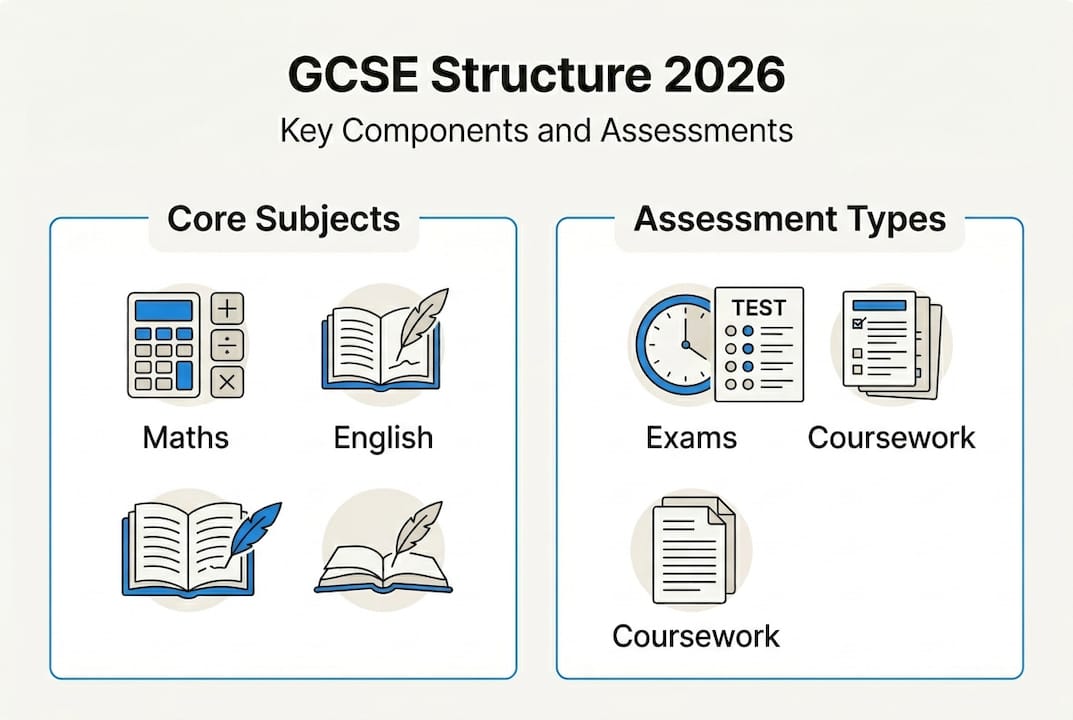
GCSE stands for General Certificate of Secondary Education. These are academic qualifications taken by UK students aged 15-16 in Years 10 and 11, typically covering 8-10 subjects including compulsory core areas. The qualifications serve as a critical milestone before students move on to A-Levels, vocational training, or employment.
Every student must study certain core subjects, whilst having flexibility to choose additional options based on interests and future plans. The compulsory subjects include:
- English Language and English Literature
- Mathematics
- Sciences, either as combined science (worth two GCSEs) or separate biology, chemistry, and physics (three GCSEs)
- Some schools also require a modern foreign language and humanities subject
Beyond these core requirements, students select from options like history, geography, computer science, art, drama, music, design technology, and business studies. Your subject choices shape your revision workload and assessment schedule, so understanding what each involves helps you plan effectively.
GCSE results open doors to further education and career paths. Strong grades in core subjects are essential for most sixth form courses and apprenticeships. If you're looking for past papers to practise with, exam archive AI provides searchable resources organised by subject and exam board, making it easier to find relevant materials for your specific qualifications.
How GCSEs are structured and assessed
GCSEs use a numeric grading scale from 9 to 1, with 9 being the highest achievement and 1 the lowest pass. This replaced the old A* to G system to provide finer distinction between student performance levels. Grade 4 is considered a standard pass, whilst grade 5 is a strong pass that many colleges and employers prefer.

Most GCSEs follow a linear structure, meaning all assessment happens at the end of Year 11 rather than spreading exams across two years. The main exam period for 2026 runs from approximately 4 May to 26 June, with students sitting multiple papers across this window. This concentrated assessment period makes strategic revision planning essential.
Some subjects include non-exam assessment components like coursework or practical work that contribute to your final grade:
- Art and design subjects require portfolio development
- Drama and music include performance assessments
- Design technology may involve creating and evaluating a product
- Science GCSEs include required practicals, though these are assessed within written exams
Knowing whether your subjects are purely exam-based or include coursework helps you allocate revision time appropriately. Here's how assessment timing typically breaks down:
| Assessment type | Timing | Weighting | Subjects |
|---|---|---|---|
| Final written exams | May-June Year 11 | 100% | Maths, English, most humanities and sciences |
| Coursework + exams | Throughout Year 11 | Varies, typically 40-60% coursework | Art, drama, design technology |
| Controlled assessment | Set periods in Year 11 | Varies | Some language speaking assessments |
Pro Tip: Create your revision schedule as soon as exam dates are confirmed, working backwards from each exam to allocate sufficient preparation time for every subject. This prevents last-minute cramming and reduces stress.
Using resources like exam archive AI during your preparation helps you familiarise yourself with question styles and mark scheme expectations, which is crucial for maximising your performance in the linear exam format.
Comparing GCSE subjects and assessment types
Understanding how different subjects assess your knowledge helps you tailor your revision approach. Most GCSEs rely entirely on final exams, but several subjects incorporate practical work or coursework that you complete during Year 11. This variation means your revision strategy needs to adapt to each subject's requirements.
Subjects assessed purely through exams include mathematics, English language and literature, history, geography, and most sciences. You'll sit multiple papers for each subject, often covering different topics or skill areas. For example, maths typically has three papers testing calculator and non-calculator skills, whilst English language has two papers focusing on reading comprehension and creative writing separately.
In contrast, subjects like art and drama include practical assessment, which forms a significant portion of your final grade. This comparison table illustrates the differences:
| Subject | Exam component | Non-exam component | Key difference |
|---|---|---|---|
| Mathematics | 100% (three papers) | None | Pure exam focus |
| English literature | 100% (two papers) | None | Closed-book essay exams |
| Combined science | 100% (six papers) | Required practicals (assessed in exams) | Heavy exam load |
| Art and design | 40% (exam project) | 60% (portfolio) | Major coursework element |
| Drama | 40% (written exam) | 60% (performance + portfolio) | Practical skills assessed |
| Design technology | 50% (written exam) | 50% (design project) | Balanced assessment |
The assessment split affects how you manage your time:
- Exam-only subjects require consistent revision building towards the summer exam period
- Coursework subjects demand ongoing work throughout Year 11 alongside revision
- Subjects with practical components need regular practice sessions, not just theory revision
Pro Tip: Prioritise coursework deadlines early in Year 11 to avoid conflicts with exam revision in the spring term. Completing coursework ahead of schedule frees up mental space and time for focused exam preparation when you need it most.
Recognising these differences allows you to create a balanced revision plan that addresses each subject's specific demands rather than applying a one-size-fits-all approach.
Practical tips for structuring your GCSE preparation
Effective GCSE preparation requires strategic planning that accounts for exam timing, subject assessment types, and your personal learning style. Following a structured approach helps you cover all material whilst maintaining balance and avoiding burnout.
Start by creating a comprehensive revision timetable aligned with your exam schedule. Work backwards from each exam date, allocating more time to subjects you find challenging or that carry more weight in your future plans. Here's a step-by-step approach:
- List all your exam dates and coursework deadlines in chronological order
- Identify which subjects need the most attention based on current performance and difficulty
- Block out dedicated revision sessions for each subject, ensuring regular practice rather than marathon sessions
- Schedule breaks and rest days to maintain focus and prevent exhaustion
- Build in buffer time before exams for final reviews and addressing weak areas
- Review and adjust your timetable weekly based on progress and changing needs
Divide your revision time strategically between different types of work. If you have coursework subjects, dedicate specific sessions to completing practical work or portfolio development, separate from exam revision time. This prevents coursework from consuming all your energy whilst exam subjects fall behind.
Past papers are invaluable for exam preparation. Using platforms like exam archive AI gives you access to authentic questions organised by topic and difficulty. Practising with real exam questions helps you understand mark scheme expectations, identify knowledge gaps, and build confidence with exam techniques.
Pro Tip: Simulate actual exam conditions when practising past papers. Set a timer, work in a quiet space without notes, and mark your answers honestly using the mark scheme. This builds exam stamina and reveals which topics need more attention.
Stay aware of all assessment deadlines and exam dates throughout Year 11. Missing a coursework deadline or arriving unprepared for a speaking assessment can significantly impact your final grade. Use a planner or digital calendar with reminders to track every important date.
Finally, remember that rest and mindset matter as much as study time. Regular sleep, physical activity, and breaks improve memory retention and reduce anxiety. Burning out before exams undermines months of preparation, so build sustainable habits that support both your mental and academic performance.
Discover exam archive AI for GCSE success
After understanding GCSE structure and preparation strategies, having the right tools makes all the difference. Exam Archive AI offers a comprehensive platform specifically designed for GCSE students, providing searchable access to past papers and mark schemes across all major exam boards.
The platform helps you practise with authentic exam questions tailored to your specific subjects and exam board, whether you're studying AQA, Edexcel, OCR, or WJEC. This targeted practice sharpens your exam techniques and builds familiarity with question styles you'll actually face.

Using past papers strategically forms a crucial part of effective preparation. Exam Archive AI organises resources by year and topic, making it easy to focus on areas where you need improvement or to complete full timed papers under exam conditions. This practical approach boosts both knowledge and confidence as your exams approach.
Frequently asked questions about GCSE structure
What does 'linear exams' mean for my revision planning?
Linear exams mean all your assessment happens at the end of Year 11 rather than spreading across two years. This requires building a comprehensive revision plan that covers all content before the May to June exam period. You cannot rely on modular exams throughout the course to build your grade gradually.
How does non-exam assessment affect my final GCSE grade?
Non-exam assessment like coursework or practical work contributes a set percentage to your final grade, typically between 40% and 60% depending on the subject. This means your coursework performance directly impacts your overall result. Strong coursework can boost your grade even if exams are challenging, whilst poor coursework limits your maximum achievable grade.
What does a grade 9 represent on the GCSE scale?
Grade 9 is the highest GCSE achievement, roughly equivalent to a high A* in the old system. It represents exceptional performance and is awarded to a small percentage of top-performing students. Grade 9 demonstrates mastery of the subject content and excellent exam technique.
When will I receive my GCSE results after taking exams?
GCSE results are typically released in late August, usually the fourth Thursday of the month. For 2026 exams taken in May and June, expect results around 20-21 August. Your school will inform you of the exact collection date and process.
How can I balance coursework and exam revision effectively?
Set clear deadlines for coursework completion well before the exam period begins, ideally finishing major projects by Easter. This allows you to focus purely on exam revision during the final weeks of Year 11. Allocate specific days or sessions to coursework versus exam subjects, rather than trying to do both in every study session, which splits your focus and reduces effectiveness.